

Overview of Industrial Market Positioning
For investors navigating the industrial manufacturing landscape in 2026, Caterpillar (NYSE:CAT) and Oshkosh (NYSE:OSK) represent two distinct approaches to capital allocation. While both operate within the broad industrial sector, their business models are defined by different growth drivers, market exposures, and financial profiles.
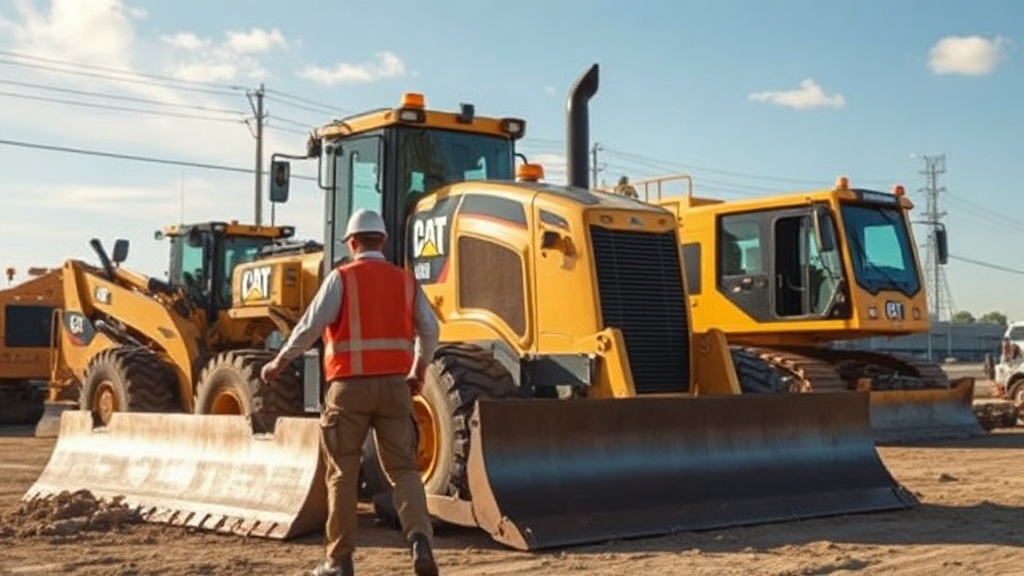
Caterpillar remains a global leader in construction, mining equipment, and industrial gas turbines. The firm leverages an extensive dealer network of more than 150 entities to maintain its infrastructure market dominance. Conversely, Oshkosh focuses on highly specialized, purpose-built vehicles, serving defense and fire services, with a significant portion of its revenue tied to government procurement.
Financial Performance Comparison
Data from fiscal year 2025 highlights the divergence in scale and operational strategy between the two firms:
- Caterpillar: Reported revenue of approximately $67.6 billion, a 4.3% year-over-year increase, with a net income of roughly $8.9 billion. The company maintained a net margin of 13.1%. Its balance sheet shows a debt-to-equity ratio of 2.0x and a current ratio of 1.4x, supported by $10.3 billion in free cash flow.
- Oshkosh: Reported revenue of approximately $10.4 billion, reflecting a 2.9% decline compared to the prior fiscal year. Net income stood at roughly $647.0 million with a net margin of 6.2%. The firm maintains a conservative capital structure with a debt-to-equity ratio of 0.3x and a current ratio of 1.9x.
Macro Drivers and Risk Factors
Caterpillar’s outlook is increasingly tied to the infrastructure demands of the artificial intelligence boom. The expansion of data centers requires substantial investment in machinery and power solutions, providing a potential tailwind for the company. However, Caterpillar remains sensitive to cyclical commodity price fluctuations and the integration of new technologies, such as the spatial data capabilities acquired through its purchase of Skycatch.
Oshkosh, meanwhile, faces a different set of challenges. Approximately 20% of its net sales are derived from U.S. government contracts, creating a reliance on federal budget cycles and procurement shifts. The company is also navigating legal headwinds, including federal class action lawsuits related to the fire truck market, and faces competition from major defense and industrial players like Lockheed Martin and PACCAR.
Valuation and Strategic Outlook
Market valuations differ significantly, with Oshkosh currently trading at lower forward price-to-earnings (P/E) and price-to-sales (P/S) ratios compared to Caterpillar. Caterpillar’s premium valuation reflects its status as a diversified market leader, though investors must weigh this against the cyclical nature of its primary end-markets.
Ultimately, the choice between these two industrials rests on an investor’s appetite for risk versus stability. Caterpillar provides exposure to global infrastructure growth, particularly in the tech-driven industrial space. Oshkosh functions more as a defensive play, characterized by lower leverage and a reliance on steady, albeit politically sensitive, government contracts.