




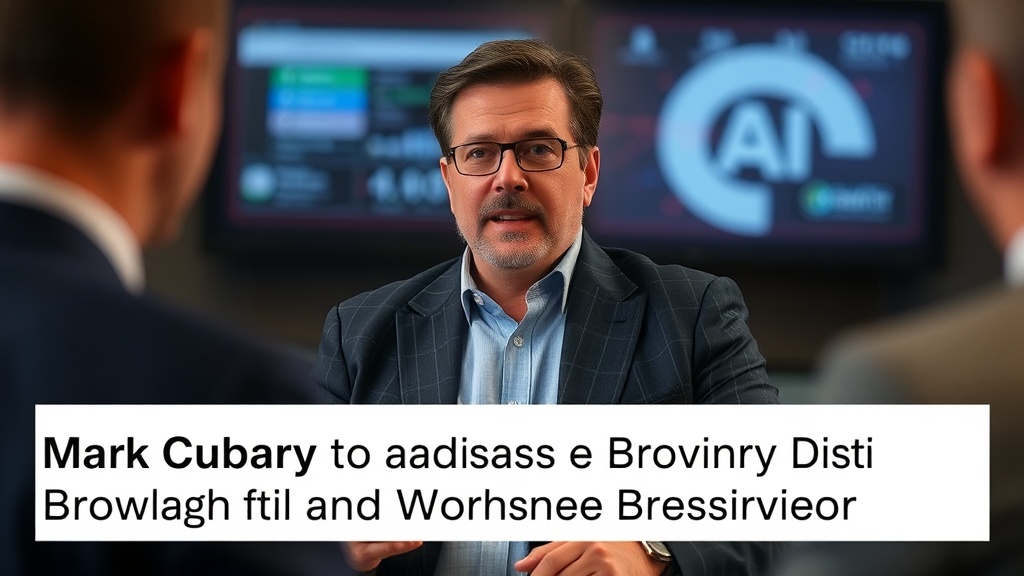
Market Tension Over AI-Driven Workforce Shifts
As artificial intelligence adoption accelerates, the corporate sector faces a deepening divide between technological deployment and public acceptance. Recent data highlights a sharp increase in layoffs attributed to AI-driven redundancies, fueling community resistance and regulatory hurdles for critical infrastructure projects.
Mark Cuban recently weighed in on the friction between AI firms and the communities impacted by the rapid shift in labor requirements. In a public critique, Cuban argued that major AI organizations are losing the public relations battle by prioritizing institutional narratives over the tangible needs of workers displaced by automation.
Data Centers as a Proxy for Economic Anxiety
The resistance to AI expansion is increasingly manifesting in the rejection of data center construction. According to data from Benzinga, the first quarter of 2026 saw at least 75 data center projects, valued at approximately $130 billion, delayed or blocked—marking the most significant disruption of its kind on record.
While local opposition often cites practical concerns such as water consumption, power usage, and noise, analysts suggest these protests represent a broader frustration regarding wealth concentration. A Gallup survey conducted in May 2026 indicated that 71% of Americans oppose the placement of AI data centers in their communities, with nearly half expressing strong opposition.
Cuban posits that these protests are a symptom of a systemic failure to address the economic displacement caused by the technology. “It’s time for everyone to realize that the fight against data centers has nothing to do with data centers. They have become a proxy for the hate towards AI and the concentration and accumulation of wealth it’s creating,” Cuban stated.
The Escalation of AI-Cited Layoffs
Corporate financial filings and industry reports confirm that AI is increasingly cited as a primary driver of restructuring. Data from the firm Challenger, Gray and Christmas illustrates a dramatic shift in company justifications for workforce reductions:
- January 2026: AI cited in 7% of layoffs.
- March 2026: AI cited in 25% of layoffs.
- May 2026: AI cited in nearly 40% of layoffs.
Prominent examples include Oracle, which cited AI adoption as a factor in its fiscal 2026 plan to cut 21,000 jobs, and Snap, which reduced its workforce by 1,000 employees as management highlighted that advanced AI tools allowed for smaller, more efficient teams.
Strategic Implications for the AI Sector
The industry faces a potential bottleneck in infrastructure development if community pushback continues to prevent the expansion of data centers. For AI firms, this represents a significant business risk. The ability to secure land and permitting for data centers is essential to maintaining the computational capacity required for large language models (LLMs).
Cuban suggests that the current industry strategy of investing in celebrity partnerships and political lobbying is ineffective. Instead, he advocates for direct engagement with local communities and creative unions. By investing in local programs and demonstrating a commitment to the regions where they operate, AI companies may mitigate the hostile environment that currently threatens their infrastructure growth. As Cuban noted, failing to prioritize the needs of the working population could ultimately impede the capacity required to sustain future business growth.