



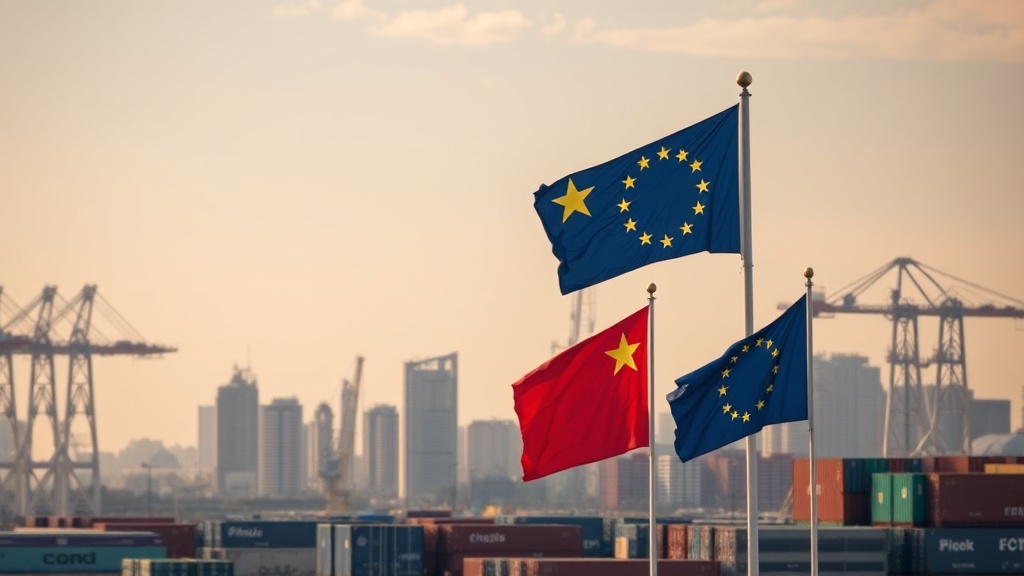
The European Union and China have officially initiated a three-month period of formal trade consultations, signaling a concerted effort to mitigate rising tensions and avoid a potential trade war. The move comes as the EU grapples with a record-high annual trade deficit with China, which currently stands at approximately €360 billion.
Addressing the ‘China Shock 2.0’
The dialogue follows weeks of diplomatic friction and rhetoric regarding the influx of Chinese goods and components into the European market. Brussels has increasingly characterized the current trade environment as a second wave of a “China Shock,” a phenomenon officials argue threatens the viability of key European industries and domestic employment levels.
According to data from Eurostat, the EU’s statistics agency, the imbalance has reached a historic scale, with Chinese exports to the bloc outweighing imports by roughly €1 billion per day as of mid-June. Maroš Šefčovič, the EU trade commissioner, emphasized the urgency of the situation following his meeting in Brussels with Chinese commerce minister Wang Wentao.
“We simply cannot afford to continue in the unsustainable growth of the trade deficit from the European perspective,” Šefčovič stated. “It has to bring tangible results, and we believe that we can achieve them by October.”
Core Objectives of the Consultations
The newly established trade and investment consultations (TIC) are set to focus on four primary pillars:
- Trade and Investment Rebalancing: Addressing the structural disparities in market access and volume.
- Export Controls: Discussing the regulatory framework for critical materials, including rare earth elements.
- Intellectual Property Rights: Strengthening protections for European businesses operating within the Chinese market.
- WTO Reform: Aligning on multilateral trade rules and dispute resolution mechanisms.
In a significant shift toward transparency, both parties have agreed to implement a joint monitoring mechanism. This system aims to move beyond standard customs data to identify sudden surges in specific product categories. The framework includes provisions for political discussions should trade indicators enter designated “amber or red” danger zones, providing an early-warning system to prevent further escalation.
Looking Toward October
The current diplomatic offensive is intended to yield concrete policy outcomes before the next high-level meeting scheduled for October in Beijing. While the European Commission has been conducting detailed mapping of import and export flows, the effectiveness of these talks remains a point of scrutiny. Previous attempts to curb the influx of Chinese electric vehicles via targeted tariffs in 2024 saw limited success, leading to speculation that future measures—such as quotas on chemicals or hybrid vehicle components—may be considered if the consultation period fails to produce a balanced outcome.
Industry groups, including the European Chambers of Commerce in China, have warned that the current import levels risk “cannibalizing” European manufacturing capacity, particularly in sectors heavily dependent on Chinese-sourced components. As the three-month window begins, the focus remains on whether political dialogue can provide a sustainable framework for one of the world’s most significant bilateral trading relationships.